
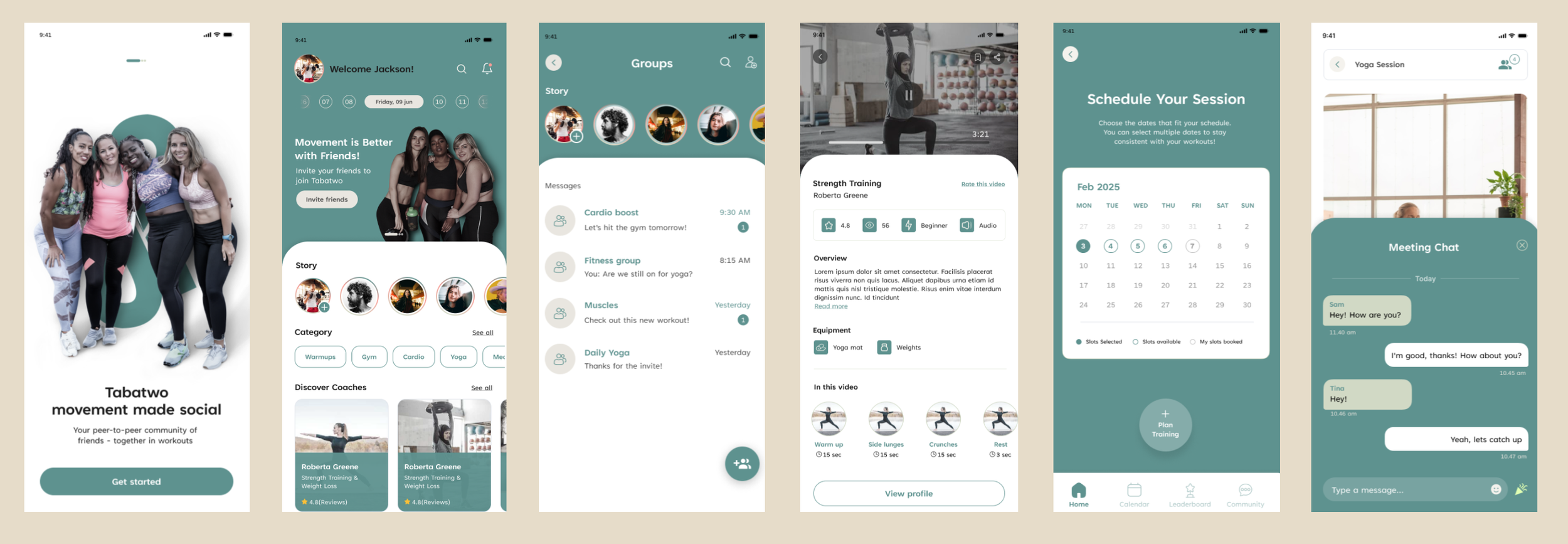
Tabatwo
Defining the core UX of a social fitness platform Tabatwo
Role: UX Consultant
Timeline: October 2025 – December 2025
Overview
Tabatwo is a social fitness platform designed to help people train together either through live instructor-led sessions or shared workouts with friends. I joined the team during a critical phase of product development, where core features were being defined and validated ahead of wider rollout.
My role was to lead user-centred design across key product areas, ensuring that foundational concepts were clear, usable, and aligned with both user needs and technical constraints. I drove UX work from discovery through validation, working closely with product and engineering to support fast, informed decision-making.
The challenge
At the time, Tabatwo offered a broad range of functionality — onboarding, workouts, instructors, scheduling, and social features — but the experience lacked a clear centre of gravity.
Key challenges included:
Users struggling to understand the app’s core value proposition early on
High-friction flows around booking sessions and starting workouts
Social features feeling disconnected from the main experience
Complexity and inconsistency across navigation and language
Early technical issues impacting trust and motivation
The challenge was not just to improve individual screens, but to help the team clarify what the product was really about, and design around that focus.
My role & responsibilities
As UX Consultant, I was responsible for:
Leading design of core product features, including:
Social workout experiences
Custom sessions and workout playback
Instructor booking and scheduling
Defining user flows and functional requirements before visual design
Planning and moderating usability testing with end users
Synthesising insights into clear, prioritised recommendations
Collaborating closely with product and engineering to ensure feasibility and alignment
Supporting faster, more confident delivery in a fast-moving environment
Approach
I led a structured, end-to-end UX process that balanced discovery, validation, and delivery.
1. Discovery & flow definition
Before moving into visual execution, I mapped key user journeys and identified high-value actions particularly around onboarding, booking, and starting a workout. This helped surface complexity early and aligned the team around what needed to be tested.

2. Usability testing
I planned and moderated task-based usability testing with five users aged 21–68. Sessions focused on first-time experience and core flows, including:
Onboarding and app clarity
Home screen and navigation
Custom workout creation and playback
Instructor booking and calendar use
Friends and social features
Sessions were moderated, think-aloud, and ran for 60–90 minutes, allowing for both behavioural insights and qualitative feedback.
3. Synthesis & prioritisation
Findings were synthesised into clear themes and prioritised based on impact, frequency, and risk. Rather than producing a long list of issues, I focused on helping the team understand what to fix first, especially where friction affected trust, motivation, or revenue-related actions.
Key insights
Some of the most impactful insights included:
Early confusion reduced trust: Users were excited by the idea of training with friends, but struggled to understand the app’s purpose within the first minutes of use.
Too many steps killed momentum: High-value actions like booking an instructor or starting a workout required too many decisions and screens.
Social was under-leveraged: Social features were central to the brand promise, but felt secondary or hidden in the experience.
Workout execution mattered most: Playback issues, unclear controls, and lack of guidance during workouts caused frustration and demotivation.
Clarity beats flexibility: Users preferred clear guidance and defaults over extensive configuration, especially early on.
Design recommendations & impact
Based on testing and analysis, I helped the team align around several key priorities:
Clarify the main offering
Focus on a single primary value proposition (training with friends or instructors) and perfect that core flow before expanding.Simplify onboarding and entry points
Guide first-time users toward a clear first action, reducing cognitive load and building early confidence.Streamline booking flows
Reduce instructor booking to a small number of clear steps, with time and price surfaced early.Improve workout session UX
Address technical reliability, clarify play/pause behaviour, and add clearer distinctions between work and rest states.Integrate social features meaningfully
Bring friends and shared workouts into core journeys rather than isolating them in separate sections.
These recommendations helped the team make more focused product decisions and laid a stronger UX foundation for future development.
Outcomes
While not all changes were shipped within the project timeframe, the work contributed to:
Clearer product direction during a pivotal development phase
Better alignment between design, product, and engineering
Reduced ambiguity around core user journeys
A shared understanding of what success should look like from a user perspective
Reflections
This project reinforced the importance of:
Using research to create focus, not just find problems
Prioritising clarity and momentum over feature breadth
Embedding a product’s value proposition directly into the UX
Acting as a facilitator and strategic partner, not just a designer
“I had the pleasure of working with Andrea Dahlen during a critical phase of product development at Tabatwo. What stood out most was Andrea’s ability to balance user experience thinking with practical execution. She ran comprehensive user testing, identified actionable improvements, and worked collaboratively with our development team to ensure designs were technically feasible. Andrea also helped us clarify fundamental product concepts that became central to our platform’s direction. She approaches design work methodically, focusing on user flows and requirements before diving into visual polish. This made collaboration efficient and kept the team aligned on what mattered most. I would gladly work with Andrea again and recommend her to any team building user-centered products.”